Video Overview
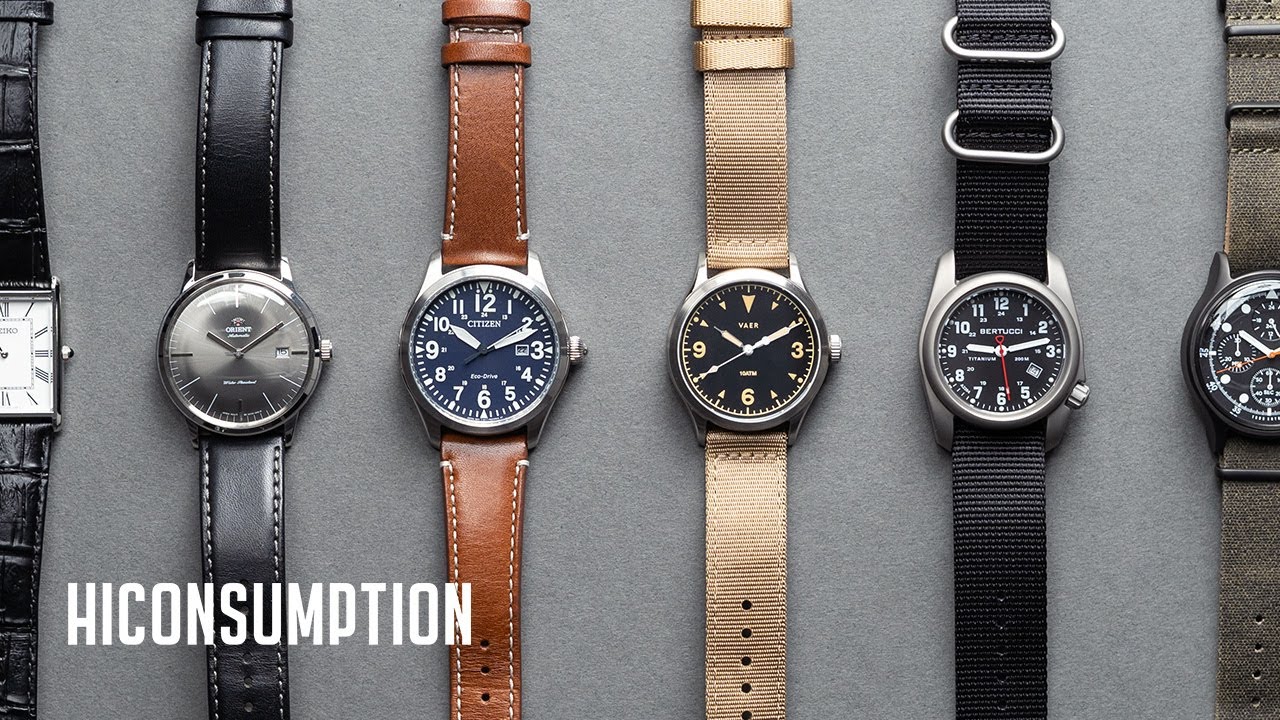
HICONSUMPTION rounds up nine of the best affordable Japanese watches — all under $1,000 — covering everything from a $30 digital icon to hand-lacquered artisan microbrands from Kyoto. Japan has been producing world-class timekeeping for over a century, and this guide makes the case for why the country’s watchmakers continue to deliver some of the best value in horology. Whether you’re buying your first serious watch or filling a gap in an existing collection, these nine picks span field watches, dress watches, dive watches, solar-atomic, and artisan pieces. Thanks to HICONSUMPTION for the detailed, well-researched breakdown on each one.
Items and/or Gear Mentioned in the Video
- Casio Royale World Time AE1200WH-1A – Purchase on Amazon
- Orient Bambino Cream Dial (RA-AC0033Y30B) – Purchase on Amazon
- G-SHOCK GW-5000U-1 – Purchase on Amazon
- Citizen Promaster Diver 44mm (BN0150-28E) – Purchase on Amazon
- Seiko SRPE41 Presage Cocktail Time “Negroni” – Purchase on Amazon
- Kuoe Old Smith 90-002 38mm Bronze – Purchase on Amazon
- Knot AT-38 Urushi Vermilion Red – Purchase on Amazon
- Namica Shirahama 2 Neo Tokyo – Purchase on Amazon
- Seiko Baby Alpinist SPB155 – Purchase on Amazon
Three picks stand out as must-considers. The Casio AE1200WH-1A — the so-called “Casio Royale” — is one of the most iconic pieces in the affordable watch world, packing world time, multi-function display, and retro field-watch styling for just $30. The Seiko SRPE41 Presage Cocktail Time “Negroni” brings legitimate dress-watch character to the under-$500 tier, with a deep burgundy enamel-inspired dial and an automatic movement that you can display through the exhibition caseback. And the Seiko Baby Alpinist SPB155 bridges field watch and mountain tool watch in a 38mm case — the right size for most wrists — with an internal compass bezel and sapphire crystal.
Editor’s Insight
Japan’s dominance in the affordable watch segment isn’t an accident — it’s the result of decades of vertical integration, precision manufacturing culture, and a design philosophy that prioritizes function over prestige signaling. The nine watches in this HICONSUMPTION roundup illustrate that spectrum well, running from mass-market staples that have sold millions of units to limited-run microbrands that operate out of Tokyo studios with single-digit production numbers per colorway.
Start at the bottom of the price range and the Casio AE1200WH-1A makes the case that a watch doesn’t need to cost more than a good lunch. The AE1200 has been called the “Casio Royale” because of its aesthetic debt to the Rolex Submariner, but it earns its own reputation on function: 31 time zones, five daily alarms, stopwatch, countdown timer, and a 10-year battery. The resin case and strap aren’t trying to be anything they’re not. For someone building their first EDC kit, this watch is often the right answer before anything else.
The Orient Bambino sits at the exact opposite end of the aesthetic spectrum — a classic dress watch with domed acrylic crystal, in-house automatic movement, and a dial that photographs beautifully at dinner. At $295, the value is extraordinary. Orient is a Seiko subsidiary that developed its own calibers independently, and the Bambino’s movement has a proven track record for long-term reliability. The cream dial variant with Roman numerals has become a gateway drug for a lot of new watch collectors, and for good reason.
The G-SHOCK GW-5000U-1 is the hardest watch on this list to argue against from a technical standpoint. It receives atomic radio signals from six stations worldwide (covering North America, Europe, China, and Japan) and uses solar charging to theoretically eliminate battery replacement forever. This is the same resin-module construction as the original DW-5000 from 1983, and Casio has refined it over four decades to the point where it is effectively indestructible. Water resistance to 200 meters, shock-resistant construction, full radio-controlled timekeeping — at $330 it’s a better technical specification than watches costing ten times as much.
The Citizen Promaster Diver BN0150-28E is the straightforward answer when someone asks for a capable diver under $400. ISO 6425 certified, Eco-Drive solar movement, 200m water resistance, and a unidirectional bezel in a 44mm case. The BN0150 is one of Citizen’s longest-running models because it doesn’t need updating — it does the job. The matte black dial and case keep it versatile enough to wear in and out of the water.
Stepping into Seiko’s Presage line with the SRPE41 “Negroni” is where affordability starts to feel like it’s bending the rules. The cocktail-time dials — inspired by the light refracting through a glass of spirits — use a textured pattern and layered lacquer effect that rewards close inspection. The 4R35 automatic movement hacks and hand-winds, making it easy to set precisely. Dress it up on the leather strap or throw it on a steel bracelet and it works equally well in both contexts. This is the watch that convinces a lot of tool-watch people that they also care about design.
The top three picks on this list — Kuoe, Knot, and Namica — represent a different segment entirely: Japanese microbrands that don’t sell at scale and don’t try to. The Kuoe Old Smith 90-002 in 38mm bronze is a field watch designed for wrists that prefer a smaller case, with a bronze case that will develop a natural patina over time. The Knot AT-38 Urushi uses a traditional Japanese lacquer technique (urushi) on the dial, applied by hand in multiple layers and polished between coats — a process that takes weeks. The Namica Shirahama 2 Neo Tokyo goes the other direction, leaning into contemporary graphic design with bold colorways and a sports-watch format that feels distinctly modern. None of these three will be found on a gray-market discount site.
The Seiko Baby Alpinist SPB155 closes the list and arguably makes the strongest overall case. Seiko’s Alpinist line has been in production since 1961, and the SPB155 is a faithful modernization: sapphire crystal, 200m water resistance, internal compass bezel, and an accurate 6R35 automatic movement rated to 70 hours of power reserve. The 38mm case fits a broad range of wrists better than the larger SPB119 sibling. It wears slim despite the complications, and the deep green dial pairs naturally with almost any strap choice. At $725 it’s the most expensive watch on the list, but also the hardest one to outgrow.
What makes this HICONSUMPTION roundup useful is the price spread — it doesn’t assume everyone’s starting point is the same. The Casio entry point exists because not every EDC setup needs to prioritize the watch. The Seiko and Citizen mid-tier exists for people who want a reliable automatic or solar movement without spending import-watch money. And the microbrand top tier exists for people who’ve already bought the easy answers and want something with a story behind it. Check out the full video on the HICONSUMPTION YouTube channel for the full breakdown on each piece.
Closing Remarks
Japan continues to set the standard for affordable watchmaking, and this HICONSUMPTION guide covers the full range — from the utility-first Casio digital to the artisan Knot Urushi. Whatever your budget or style, at least one of these nine belongs on your wrist. Tell us in the comments which one you’d choose, or which Japanese watch is already part of your daily carry. All product links above are affiliate links — clicking them helps support this site at no extra cost to you.